How to Remove Ticks from a Dog. Ticks, Pyroplasmosis - Signs, Consequences, Treatment. Types of Ticks.
Ticks in dogs - how to detect and remove them. Pyroplasmosis - signs, consequences, and treatment methods. Tips from breeders.
Contents
During the period from spring to late autumn, while walking outdoors, our four-legged friends face the danger of ticks.
Timely response to the appearance of these bloodsuckers on the animal's body can help preserve the health and life of your pet. Moreover, removing a tick from a dog can be done at home.
How to find a tick on a dog.
Since dogs are susceptible to tick attacks in areas with bushes, tall grass, or deciduous forests, it is essential to make it a habit to inspect your pet after every walk. Sometimes finding a tick on a dog requires considerable effort. Start your examination from the snout and ears, then carefully check the armpits and groin area, and then move from the spine to the sides.
The denser the fur on the animal, the harder it is to detect the parasite. So, sift through the fur with your fingers, lifting the hairs and inspecting the undercoat. Also, feel the skin of your pet with your fingers. Try to do this with gentle strokes, not missing a single centimeter of the skin surface.
If you have never encountered bloodsucking parasites before, to determine if a tick has bitten your dog, look at the PHOTOS of parasites on the skin of animals.
Finding a tick on a dog is easier both visually and through palpation when it has already fed on the animal's blood. After sucking the dog's blood, the parasite can grow to the size of a pinhead and sometimes even a small bean.
Dog behavior when bitten by a tick.
In addition to visually inspecting your four-legged pet, observe the dog's behavior, which changes when bitten by a tick. The first signs indicating a parasite attack on your pet appear within a couple of days and include:
- Decreased activity of the dog. Lethargy manifests as a reluctance to play or go for walks. The dog may refuse to eat. Pay special attention to the fact that the animal approaches the food bowl, sniffs the food but does not eat it, only lapping water.
- Depressed state. The animal hides in secluded corners of the apartment or house and does not respond to the owner's commands.
- Sleepiness. The pet starts sleeping more than usual. It reacts aggressively to your attempts to wake it up.
- The four-legged friend starts rolling on the floor or rubbing against furniture, corners, and doorways. This way, the dog tries to relieve the itch at the tick bite site.
In Toy Terriers, as in all small dog breeds, symptoms of tick infestation begin to manifest literally within 6-7 hours. For medium and large breeds, the time frame for the first symptoms of a tick bite, known as the encephalitic tick in dogs, can be up to two days.
What to do if your dog has a tick.
If ticks are found on dogs, they need to be removed. Here’s how to do it.
Of course, for those who are encountering parasites on their pet's skin for the first time, the best option for extracting the parasite is to consult a veterinarian. This way, you not only help the animal but also learn how to remove a tick from a dog in the future, so you can manage without the help of a dog doctor next time.
But if for any reason you cannot consult a veterinarian, use our step-by-step guide on how to remove a tick from your dog's skin:
- Under no circumstances, immediately after detecting the parasite on the dog's body, try to pull the dog out of the tick's grasp. It sounds a bit funny, considering the size of the tick. Act slowly.
- After detection, before directly neutralizing the parasite attached to the dog's skin, treat the tick with oil. Regular vegetable oil used for frying or salads is suitable for this. A thin layer of oil will act as a kind of seal for the tick's breathing channels. Suffocating, the tick begins to weaken its grip, which is exactly what we need.
Tip: Instead of sunflower oil, you can seal the tick using nail polish, cream, petroleum jelly, or another substance that blocks oxygen.
- Your next task will be to twist the bloodsucker out of the animal's body. You can do this with tweezers, gripping the tick's body gently so as not to crush it. Alternatively, you can wrap the tick at the point where it has attached to the dog with a thread to create a "noose."
- Only after this, twist the tick out. There should be no rush; otherwise, a part of the parasite left in the dog's skin can provoke inflammation and decay.
Tip: You can remove a tick from a dog's skin using a special effective tool – a tick twister. A specially bent handle with a hook at the end helps not only to lift the bloodsucker but also to completely extract it from the animal's skin.
How to treat a tick bite on a dog.
After the parasite is twisted out of the pet's body, the tick bite site on the dog should be treated. With what? With any disinfectant. You can treat the tick bite with iodine or alcohol. This is essential because if the parasite is not promptly removed from the animal's body and the tick bite site is not treated, serious long-term treatment will be required. Otherwise, a fatal outcome is possible.
Consequences of a tick bite on a dog.
Be prepared for the fact that discovering and removing the parasite from your four-legged friend's body is only half the battle. You must be ready for the consequences of a tick bite on a dog, which can be very severe. We are not trying to scare you, but to warn you. And those who are warned are armed. So, since parasites are carriers of many serious diseases, our task is to inform you about the main ones:
- The most common disease in dogs after a tick bite is piroplasmosis, also known as babesiosis. Piroplasmosis is also referred to as tick-borne encephalitis in dogs. However, the treatment for babesiosis differs from that for encephalitis. So as not to confuse you, let’s clarify that we will be discussing piroplasmosis, which dogs are most susceptible to after a tick bite.
- Less common diseases include bartonellosis, borreliosis, ehrlichiosis, and hepatozoonosis.
The pathogens of these diseases, entering the dog's blood "thanks" to ticks, deal a severe blow to the vital systems of the animal. Both the circulatory and nervous systems are affected.
The diseases that ticks "bestow" upon dogs are fast-moving, especially piroplasmosis. If the symptoms of this disease are not identified in time and the animal does not receive medical assistance, in 98% of cases, a fatal outcome occurs.
First signs of piroplasmosis in dogs.
First, let’s clarify what piroplasmosis in dogs is. This is a blood-parasitic disease (also known as canine babesiosis) of non-infectious origin. It is impossible to contract babesiosis from another dog. The carriers of piroplasmosis are ticks of the Ixodidae family.
The causative agent of piroplasmosis (Babesia canis) is transmitted to your four-legged friend by the tick during the bite. Babesia canis is located in the salivary glands of the parasite and enters the dog's bloodstream during the bite.
Typical symptoms of piroplasmosis in dogs include:
- Lethargy and weakness;
- Refusal to eat;
- Temperature rise to 40, and sometimes up to 42 degrees.
As a rule, the owner of an animal infected with piroplasmosis rarely pays attention to such a state of the pet. Moreover, sometimes after two to three days of the initial stage of the disease, the dog shows improvement in its overall condition. Naturally, the owner calms down, attributing lethargy and fever to the eternal reason – "it ate something."
But unfortunately, babesiosis is a treacherous disease. Lurking in the animal's body for several days, it begins to progress:
- The overall condition of the dog deteriorates rapidly;
- The animal refuses to eat;
- The pet's mucous membranes become pale or jaundiced;
- The animal develops persistent shortness of breath;
- The pet stops responding to its surroundings;
- The pulse is weakly palpable;
- The most characteristic sign of piroplasmosis appears – dark urine;
- Vomiting and diarrhea may occur (but not always);
- The late stage of the disease is characterized by jaundice.
Treatment of piroplasmosis in dogs.
If a dog has contracted babesiosis, treatment involves not only eliminating the causative agent of piroplasmosis but also active comprehensive therapy aimed at eliminating the consequences of parasitism in the animal's body. But let’s go through everything in order.
So, here’s how to treat piroplasmosis. To eliminate babesia in the dog's body, it is necessary to use any of the antiparasitic drugs:
- Veriben;
- Berenil;
- Azidin-vet;
- Pirosan;
- Imizol;
- Piro-Stop (imidocarb).
These effective medications should be administered strictly according to the accompanying instructions, calculating the dosage based on the dog's body weight.
Tip: Simultaneously with the use of the antiparasitic drug, veterinarians recommend a course of antihistamine medication.
As we mentioned earlier, killing the parasites is not enough; the dog's body needs recovery. Full restoration of all body systems is possible with comprehensive therapy:
- Preserving the kidneys. Therapy for preserving the animal's kidneys involves alkalizing the urine. You can protect your pet's kidneys using regular baking soda or the medication Blemaren. These substances are administered once a day in the following doses: 1 gram of pure soda or half a tablet of Blemaren per 5 kg of the animal's weight. Alkaline therapy is conducted until the dog's urine becomes light.
- Removing hemoglobin. The fact is that antiparasitic drugs destroy the dog's red blood cells. As a result of massive red blood cell death, free hemoglobin is formed, which can crystallize and block the kidney tubules. Therefore, it is necessary to speed up the removal of hemoglobin.
This can be done at home either by using subcutaneous drips of saline/Ringer's solution or by giving the animal regular water, sweetened water, or broth. Keep in mind that you can only give your pet liquids if it is not experiencing vomiting.
Tip: If the dog drinks a lot of fluids but produces little urine, the well-known diuretic Furosemide can help remove urine.
- Protecting the stomach and simultaneously removing toxins can be achieved with regular Smecta.
- General support for the entire body can be managed with a complex immunomodulating drug, Gamavit.
- When treating piroplasmosis in dogs, it is necessary to support cardiac function; therefore, to avoid heart failure, provide the pet with a course of Sulfokamfokain. If the dog exhibits convulsive states, Valocordin or Corvalol will be necessary.
- Supporting the liver, which has been affected by the blood-parasitic disease, can be achieved with medications designed for humans but effectively helping animals as well. These include Karsil, Heptral, and Essentiale.
The best tick prevention products for dogs.
Every dog owner thinks about how to primarily protect their pet from tick bites and the risk of contracting dangerous diseases rather than treating them afterward.
Comprehensive prevention and vaccination significantly reduce the risk of infection and increase the chance for the animal to endure the virus in a mild form. The best remedy for ticks for dogs is acaricidal products, which can be purchased at any pet store or veterinary pharmacy.
Preventive medications.
Preventive medications for diseases caused by tick bites vary in price and effectiveness and are available in the form of drops, sprays, tablets, and collars.
The most reliable means of protecting your pet are drops that prevent bloodsucking parasites from attacking. The drops should be applied to the dog's withers, as the animal cannot lick them off in that area.
The protection provided by drops is effective for 2-3 weeks. But this is provided that the product is applied according to the instructions: the animal's skin is clean and dry, the dog was not bathed for two days after application, and it did not get wet in the rain. All this is necessary for the active ingredient to penetrate the subcutaneous fat and reach the hair follicles and sebaceous glands. Only then can you be at ease about your pet.
The most sought-after and effective drops available today include:
- Merial – Frontline Combo.
- Bayer – Advantix.
- Hartz – Hartz Ultra Guard.
You can choose which drops are best suited for your dog by reviewing a brief description of these products.
Available
Safe for use
— puppies under 2 months
Optimal price-quality ratio
4 dosage options depending on the dog's size
— puppies under 7 weeks
Affordable
4 dosage options depending on the dog's size
No allergic reactions in the animal
You can choose another product. The main thing is that the tick repellent (repellent) or parasite killer (insectoacaricide) you choose reliably protects your four-legged friend.
Types of ticks in dogs
Unfortunately, neither humans nor their four-legged friends are immune to tick attacks. A caring owner will always inspect their pet after a walk to ensure there are no parasites attached to the dog's body. But it is one thing to confirm the absence of parasites, breathe a sigh of relief, and feel secure about the pet's health. It is entirely different when a tick or clear signs of a parasite's presence are found on the dog's skin.
A tick is a general name for a large group of arthropod subclasses. There are nearly 50,000 species of ticks. Many of them are harmless to both humans and animals, and some even provide benefits. But unfortunately, we are talking about those parasites that cause serious harm to the health of dogs. The dangerous and most commonly encountered ticks in veterinary practice for dogs include:

— sarcoptiform ticks (ear or scabies tick).
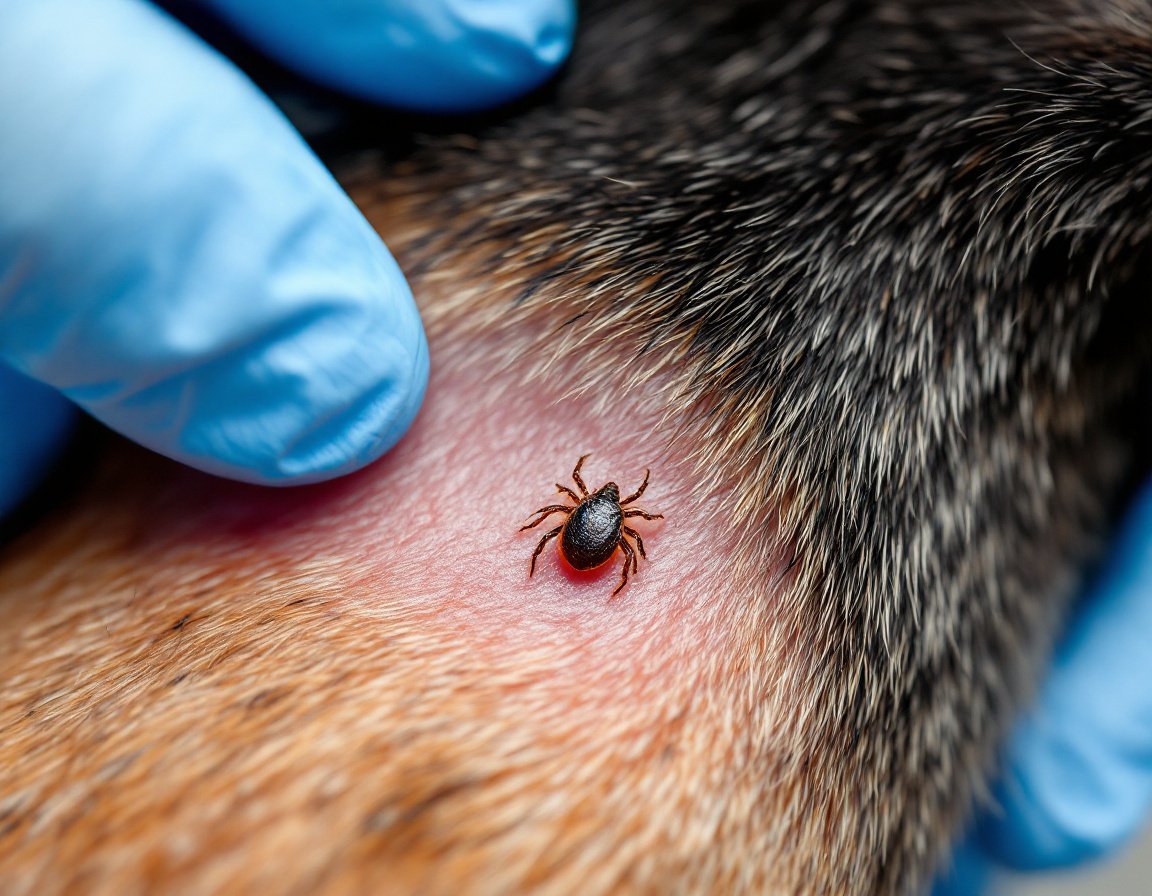
Ixodid ticks.
Diseases in dogs from ticks.
When it comes to ixodid ticks, spring and autumn periods see outbreaks of parasite infestations in animals, provoking diseases in dogs such as:
- Piroplasmosis, which affects the dog's nervous system and negatively impacts its internal organs.
- Tick-borne borreliosis, also known as Lyme disease. This disease affects the dog's heart and nervous system, as well as its joints.
- Bartonellosis, causing problems in the cardiovascular system with subsequent damage to the brain.
- Granulocytic and monocytic ehrlichiosis. The name arises because, in this disease, the affected blood cells are monocytes and granulocytes.
- Hepatozoonosis, negatively affecting the neutrophils and monocytes in the animal's blood.
Sarcoptiform (scabies) parasites provoke specific diseases depending on the type of tick:
- Sarcoptosis.
- Demodicosis.
- Cheyletiellosis.
- Notoedrosis.
- Otodectosis.
And while all except the last disease are characterized by damage to the epidermis of the entire skin of the dog, otodectosis affects the animal's ears, spreading to the inner parts of the ear.
Subcutaneous tick in dogs.
The cause of demodicosis in dogs is the microscopic subcutaneous tick of the genus Demodex canis, also known as the hair follicle mite. It is impossible to see what a subcutaneous tick looks like in dogs with the naked eye, as its size does not even reach one millimeter.
When the microscopic pest gets onto the animal, it literally burrows into the thickness of the skin to approach the sebaceous glands near the hair follicles. This place becomes a kind of dining room for the parasite, as its food consists of the secretion and then the gland itself. The path that the tick gnaws on its way to the sebaceous gland fills with intercellular fluid – a favorable environment for bacteria to multiply.
As soon as the parasite consumes the sebaceous gland, it moves on to the next one, and so on. The path of the female is littered with thousands of eggs, from which new parasites will hatch in a week.
Within a month from the start of the first egg-laying by the female tick, a colony of mature individuals (as shown in the picture) numbering from 2,000 to 5,000 forms under the dog's skin:

The symptoms of demodicosis in dogs are pronounced, as seen in the PHOTO below, since all the movements of the ticks and their excretions cause the animal severe itching. The pet may scratch for several hours straight.
The disease begins with visible redness on the dog's skin near the base of the fur, which starts to bubble a couple of days later. The contents of the bubbles are visible due to their unusual color, first brick-red, then clay-colored. When the bubbles burst, which happens after another 3-4 days, hair loss begins, and a clay-like substance spills out. The smell is terrible.
The form of demodicosis in which bubbles burst on the dog's body is called pustular or pustular demodicosis.

However, it can also happen that there are no purulent bubbles on the body, and the fur is matted together with dry scales that resemble dirt burnt in the sun or fish scales. Only when the dog's fur falls out along with the scales can purulent formations be seen under the skin.
In addition to severe itching, bloody sores on the skin, crusts at the scratch sites, hair loss, and inflammation of the skin with the formation of scales, the dog's body temperature may drop. The overall condition of the animal is depressed and lethargic.
It should be noted that contrary to popular belief, demodicosis is not contagious to humans; this "dog" disease does not transmit to people.
Treatment of demodicosis in dogs involves comprehensive therapy aimed at destroying the causative agent of the disease, removing toxins from the animal's body, restoring immunity, and strengthening the pet's body.
Treating subcutaneous ticks in dogs should only be done in a veterinary clinic under the constant supervision of a veterinarian.
Found a mistake or outdated advice? Write to us and we will fix it.