How to Understand Your Dog: Dog Body Language
Want to understand your pet? Learn key principles and download our body language poster!
Contents
Let dogs not talk, but they have their own language. It is the language of energy. The energy emitted allows the animal to sense its counterpart. Is it strong or weak, calm or irritated, relaxed or about to attack? Animals instantly pick up on this energy. And this energy is emitted not only by your pet's peers but also by you. The energetic language cannot be deceived; it is always genuine. To understand the psychology of a dog's behavior, it is essential to comprehend how they feel about us and how they perceive us.
A dog sees you as its pack. From the very first moments of entering your home, it tries to catch and understand who you are to it – a leader or not. Many dogs are naturally followers. Therefore, your task is to become a leader for your four-legged friend, even if it's a small pack. And as a leader should, you must radiate calmness in all matters. Your leadership position should form the basis of such a complex yet fascinating process as the psychology of dog training.
The Psychology of Small Dogs
The life cycles of dogs of all breeds are quite similar, especially regarding the age up to one year. After that, minor differences appear. However, it should be noted that small representatives of decorative breeds go through each phase of development earlier than large breed representatives.
You cannot approach a dog's behavior with a human measure. You need to learn to understand it. Understand what motivates its behavior, its values, how learning occurs, and why the pet behaves the way it does. Only a deep understanding of all these aspects will help establish a close bond between you and your four-legged friend, which, in turn, will bring immense pleasure from communicating with your pet.
The owner of a decorative dog must never forget that the distant ancestor of their pet is the wolf. And since the wolf is an animal living in a fairly stable social structure with a clear hierarchy, one must base the upbringing of the animal on this. The wolf that is the leader of the pack did not become one by constantly behaving aggressively towards other pack members. Rather, it earned the respect of its pack, which is regularly demonstrated to it. The same goes for our smaller brethren. Only mutual respect will become the thread that will be stretched between you and your dog for many years. The dog respects you as a leader. You respect it as a member of your pack.
The modern dog has been bred through selection. Breeders have retained qualities they deemed useful. Sometimes even using deviations from the norm. Therefore, certain breeds exhibit behavioral patterns that are not characteristic of their distant ancestors. However, no matter how much breeders work on the qualities and characteristics of our smaller brothers, wolf-like traits will remain paramount as an unchanging instinct. For example, dogs, like wolves, have a certain reflex – territory protection. This manifests through marking boundaries with urine and feces. A house dog does not need to guard its territory; however, the pet will insistently mark the area for walks.
A dog's temperament is influenced by the environment in which it grows and develops. Of course, the breeder sees the genetically determined potential of the puppy. But after the little one ends up in your home, it is you who must make every effort to ensure pleasant interactions with people for the puppy.
Pay attention to the period of development from eight to eleven weeks. This time frame is crucial for imprinting fear. In the memory of a small puppy that experiences fear during this time, this feeling and the circumstances associated with it will be deeply etched. Eradicating fear is a problematic task. Owners must be aware of the main feature of this period. To do this, avoid sharp screams, traumatic situations, and especially physical punishment.
The emotional state of a dog in fear manifests in its physiology and behavior. The pet's reaction may seem strange and incomprehensible to you. Most often, the owner is unable to understand what is happening with their four-legged friend. The dog may stop eating, resist going out, or avoid interacting with family members. Or, conversely, it may behave very excitedly. The owner must direct all their efforts towards restoring the animal, using behavioral therapy: petting the dog, speaking gently to it, treating it with its favorite treat.
Regarding stressful situations, strong stress for a dog leads to a weakened resistance of the body to other types of stress. Prolonged stress can cause hormonal changes in animals. There are many causes of stress for our four-legged friends: keeping the animal on a chain, social isolation, strict collars, punishments, pulling on the leash, training in large groups of other dogs, etc.
The fact is that behavioral changes caused by stress in your pet are often mistakenly considered problematic behavior. And attempts to correct it through harsher training can lead to even greater problems. Issues with an animal's behavior can be avoided if a trusting contact is established between the owner and the pet. The reaction of the four-legged friend is always oriented towards the owner. For the pet to be calm, the owner must be calm.
The Psychology of Friendship with a Dog
The foundation of any true friendship is respect, understanding, and mutual attentive communication. And the fact that dogs do not speak human language is not a problem.
From the puppy age, you, as an owner, should become a friend to your pet. Be interesting to it. Spend a lot of time with your four-legged friend. At the dog park, do not stand aside waiting for the dog to do its business; play with it. For this, take a ball or another toy with you. If you don’t have a toy, you can make do with a stick.
Don't forget to praise your pet. Obedience and following commands definitely require rewards in the form of treats. Even when the dog is not required to follow commands, just pet it and talk to it.
Engage in sports with your pet. This can be a morning run together, overcoming an obstacle course, etc. The benefits of such joint activities are immense. Besides getting yourself in great physical shape, you won’t achieve the bond that arises between you and your four-legged friend through any coercion.
The Psychology of Dogs. Basics of Dog Training
Dog training is based on various methods. Let's look at the disadvantages and advantages of each.
Mechanical Training Method
This method involves physical or painful impact on the animal: pulling the leash, a slap, a hit with the leash or a stick. Mechanical impact ensures unquestionable obedience to any commands. However, one cannot expect trusting relationships between you and the pet in this case. The animal lives in a constant state of fear, obediently following the owner's commands. Commands are executed under coercion.
Reward-Based Training Method
This method develops a conditioned reflex: perform the command – receive a treat. While teaching commands, the owner holds some treat above the dog’s head. The pet, knowing it will receive a tasty reward, hurries to fulfill the required action. However, constant feeding of the animal leads to a loss of interest in activities and unwillingness to follow commands.
Contrast Method
Alternating between mechanical and reward-based methods leads to the most robust contact between the owner (trainer) and the dog. A clear command with a gentle tug on the leash or a light tap on the rear without excessive force and harshness compels the pet to obey. After that, the dog immediately receives a treat. This method is popular due to the quick positive results it yields in training.
Imitation
This method is used in hunting dog training and herding services. Training puppies is placed on the "shoulders" of adult dogs, which teach the young ones to perform their duties.
Dog training is based on a sequential transition from simple to complex. First and foremost, the owner must make it clear to the dog what is required of it. For example, if the command "Sit!" is being practiced, the dog's bottom is pressed to the ground. Correct actions are rewarded, while incorrect ones are not.
In the initial stage of training, pay attention to the place where you plan to train your friend. There should be no distracting external stimuli that provoke stress and fear in the dog. Choose a quiet, secluded place for training.
Practicing commands and developing a conditioned reflex is reinforced through numerous training sessions. Gradually complicate the work for the dog by changing the conditions. If you trained the pet in a quiet corner of the park, start moving towards alleys where people walk. Then require command execution in crowded, noisy places with passing traffic. Gradually complicating the training process will help your dog avoid stressful situations and allow it to follow commands more quickly.
The owner has a tremendous influence on their pet. All the little details that people often overlook are important to it — voice, gestures, movement style, facial expressions, individual scent. Rough treatment or a sudden gesture can provoke aggressive behavior towards the owner. Conversely, a barely audible timid command and uncertain hand movements will give the dog a sense of superiority over you. Complete obedience and the absence of fear are achieved through proper relationships, strong contact, and mutual trust.
How to Understand a Dog?
Today, dog psychology is receiving more attention. Every owner has a chance to understand the nuances of the relationship between humans and dogs. We recommend reading books that provide a complete understanding of the psychology of our smaller brothers.
Jen Fennell's book "How to Understand Your Dog" is intended for dog owners who are "ready to become a little dog" to understand their pet. The revolutionary training method proposed by Jen has been in use for several years.
Leon F. Whitney, in his book "Dog Psychology: Basics of Dog Training," discusses the mechanisms of behavior, various reflexes, phobias, temperaments, and the mental and psychological capabilities of animals, without which full training is impossible.
Seminars are held, and television projects are released on the topic of "The Art of Communicating with Dogs." On YouTube, those interested can watch and listen to dog behavior specialist Antoine Nadjarian. His "Dog Psychology" teaches how to properly raise a pet so that you won’t regret your actions later.
Treat your dog, first and foremost, as an individual with its own character, traits, and attachments. A receptive animal, living in affection, care, and love, will, in return, gift you a wealth of positive emotions.
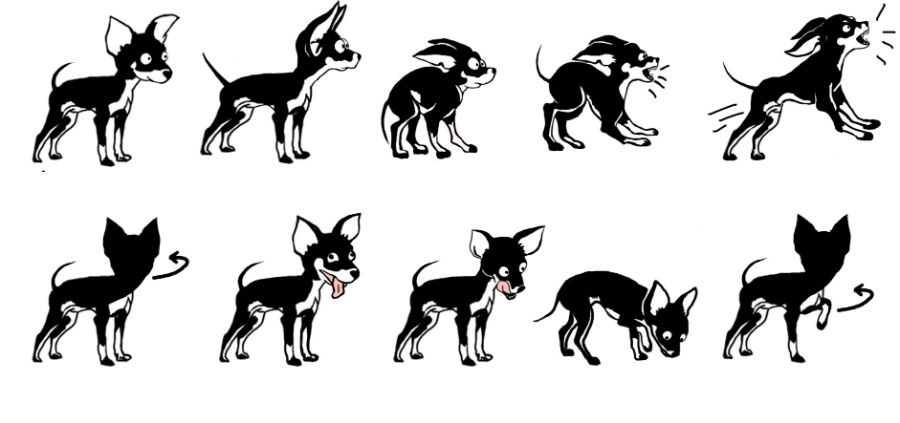
Poster "Dog Body Language. How to Understand a Dog."
And finally, we want to show you our poster with a map of a dog's emotions. Save it for yourself!

Frequently Asked Questions
How can I tell if my dog is feeling uncomfortable?
A dog may show nervousness through pinned ears, a tucked tail, or avoidance of contact. Also, pay attention to its behavior and energy.
Why does my dog try to dominate other dogs?
This may be instinctive behavior related to territory protection or the desire to take a leading position in the pack. It is important to establish respectful boundaries.
How can I become a good leader for my dog?
Be a confident and calm leader who respects the dog and establishes clear rules. This will help create trusting relationships.
Why do small dogs behave differently than large ones?
Small dogs go through developmental stages faster, and their behavior may differ due to selective breeding traits. Nevertheless, instincts remain similar.
How can I establish a connection with my dog?
A deep understanding of its behavior, needs, and values will help you establish a strong bond. Communication and respect play a key role.
Found a mistake or outdated advice? Write to us and we will fix it.