Diseases of Russian Toy Terriers
Owners of decorative dogs agree that diseases in Russian Toy Terriers can have serious consequences if not addressed promptly.
Contents
Nothing is worse than when children and... pets are sick. For those who do not have a dog at home, the comparison may seem somewhat inappropriate. But owners of decorative dogs will agree that illnesses in Russian Toy Terriers can lead to serious consequences if not addressed in time.
With proper care, if there is no genetic predisposition or hereditary diseases, the dog will not get sick. Deviations from the proper maintenance of your four-legged friend lead to immediate reactions from the body, which result in illness. Coddling a Toy Terrier, expressed in overfeeding, inappropriate clothing, and infrequent walks, will negatively affect the pet, just as a careless attitude towards the animal will. There should be no extremes in dog care. Everything is perfectly clear, as breeders and veterinarians recommend. And then no illness will scare a Toy Terrier.
But, to be fully prepared, let's familiarize ourselves with the most common diseases in Toy Terriers.
Common Diseases in Toy Terriers.
Typical diseases of the Russian Toy Terrier and the smooth-haired variety can be divided into several categories.
Musculoskeletal System.
Even if we do not take into account the genetic predisposition of Toy Terriers to various dislocations and fractures, the activity and curiosity of this decorative breed can lead to trouble. Watch your pet as you would a small child, ensuring they do not jump from heights, leap from your hands, run wildly, or weave between people's feet. Owners themselves complain that due to the dog's agility and friendliness, they sometimes step on the animal.
Hereditary pathologies cannot be cured, of course. But when choosing a Toy Terrier puppy, be sure to meet the parents of your future pet and, if possible, study the breed line.
Genetic anomalies manifest at a young age, before the animal reaches its first birthday. The most common dislocations and fractures are associated with the shoulder-scapular joint, forearm bones, humerus, carpal bones, and patella. Between the ages of six and nine months, a dog may develop a disease in the form of a genetic anomaly known as hind limb lameness, scientifically called avascular necrosis of the femoral head. This disease is named Legg-Calvé-Perthes. The danger of this condition lies in the atrophy of the dog's hind limbs, starting from the age of one year.
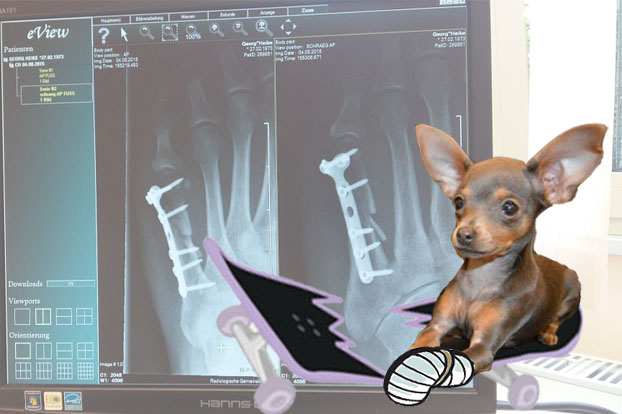
All issues related to diseases of the musculoskeletal system in Toy Terriers require long-term treatment. In cases of fractures, the veterinarian will set a pin, and in cases of dislocations, prosthetics may sometimes be required.
Eyes.
Here, all owners should also thank the dog's genetics. The predisposition to eye diseases results in cataracts and progressive retinal atrophy. However, this usually occurs only after the pet reaches five years of age. In general, cataracts in humans also primarily occur in old age. Therefore, special attention should be paid to the vision of "seniors."
In addition to these serious diseases, Russian Toy Terriers are prone to conjunctivitis. The mucous membrane of the eye becomes inflamed due to bacteria or viruses that the miniature dog's body cannot fight off. Conjunctivitis itself should be viewed as a consequence. The cause lies in the weakened body and reduced immunity of the animal.
An infection entering the eye or a wound on the eyeball membrane can lead to a disease called keratitis (inflammation).
For more details on why a Toy Terrier may have watery eyes, read our article linked here.
Teeth.
The Toy Terrier is a frequent visitor to dog dentists. Diseases related to the chewing organs in small terriers include early tartar formation, bleeding gums, cavities, periodontal disease, tooth loss, and destruction. For more information on caring for Toy Terrier teeth, read the linked article.
Neuralgia.
Decorative miniature breeds are susceptible to hydrocephalus, atlantoaxial instability, and portosystemic shunt.
Allergy.
A hereditary disease that may not manifest for some time. The allergen that triggered the allergy will reveal this disease in all its glory.
Digestive Tract.
Pancreatitis, food poisoning, overeating, cholecystitis, gastritis, constipation, diarrhea, and vomiting. These digestive system problems are primarily caused by owners' unwillingness to feed their pets properly.
Skin Diseases.
Increased sensitivity of the skin reacts immediately to internal and external negative factors, causing various redness, the formation of purulent inflammations, and, consequently, eczema.
Other Diseases.
These include viral diseases that a puppy may catch if it has not been vaccinated, as well as hypothermia/overheating.
Diseases of Toy Terriers. Symptoms and Treatment.
Ring all the bells, or rather call your veterinarian, if you notice the following symptoms that indicate a Toy Terrier is ill:
- The pet seems sad, does not run to greet you when you come home, refuses to go for walks, and does not play its favorite games.
- Unnatural-colored discharges from the dog (black, white, greenish stools, etc.), urine with blood spots. The dog's feces have an unpleasant odor.
- Change in stool consistency (diarrhea) or complete absence of stool (constipation).
- The pet's body temperature rises above 39 degrees Celsius.
- The little dog refuses to eat but starts drinking a lot.
- The skin has taken on a reddish hue or changed its natural color to an unnatural one. The coat has lost its luster and appears dull.
- Discharges from the eyes, nose, and ears. The Toy Terrier becomes sensitive to light. The cornea of the eye has clouded.
- The Toy wobbles while walking. The gait is uneven. Clear signs of seizures are visible in a lying dog.
- Walking is difficult for the dog; every step causes pain, evidenced by limping and changes in the positioning of its paws. The Toy Terrier starts to twist them.
- The dog circles aimlessly, bumping into various objects.
- The dog is constantly trembling and whimpering. When pressure is applied to the abdomen, it whines and begins to arch its back.
- Sudden shedding occurs, and in areas where the fur has fallen out, new hair does not grow.
- A dry nose in a Toy Terrier is not always a symptom of illness. The nose can be dry in dogs during and after sleep, in pregnant and nursing mothers.
The owner's attentiveness to their pet sometimes lies in intuition. You will always know if something has happened to your Toy Terrier, even if none of the symptoms are listed above.
External manifestations are dangerous when there are no apparent reasons or explanations for them. A one-time episode of diarrhea or vomiting in a Toy may be caused by some digestive system disorder or a stressful situation. If this does not repeat during the day, then put the pet on a diet and give a teaspoon of enterosgel. However, if the Toy Terrier has diarrhea for more than a day, has vomited all its food, and the vomiting spasms do not stop, then — rush to the veterinarian.
In general, it should be noted that in 90% of cases of illnesses in Toy Terriers, whether smooth-haired or Russian, the cause lies in improper feeding. Hence the vomiting and diarrhea, problems with teeth, eyes (yes, don't be surprised), and the musculoskeletal system. Plus, untimely vaccinations and improper care.
Regardless, as soon as you notice clear symptoms of illness in a Russian Toy Terrier or a smooth-haired one, entrust their treatment to a professional. Only a veterinarian can diagnose the disease, select medications, and choose the appropriate treatment regimen. Do not attempt self-medication.
Frequently Asked Questions
What diseases are most commonly found in Russian Toy Terriers?
The most common issues in Russian Toy Terriers are problems with the musculoskeletal system, as well as eye diseases such as cataracts and progressive retinal atrophy.
How can diseases in Toy Terriers be prevented?
Proper care, balanced nutrition, and regular walks will help prevent diseases. It is also important to avoid extremes in care and monitor the pet's activity.
What should I do if my Toy Terrier shows symptoms of illness?
If symptoms of illness appear, you should immediately consult a veterinarian for diagnosis and treatment.
What are the signs of lameness in a Toy Terrier?
Lameness may manifest as difficulty moving, an unnatural posture, or changes in the dog's usual behavior.
When can eye diseases develop in a Toy Terrier?
Eye diseases, such as cataracts, typically develop no earlier than five years of age.
Found a mistake or outdated advice? Write to us and we will fix it.